Key takeaways
- Peru's 2024 coffee shipments hit $1.08 billion, up 31% year on year, with volume near 3.96 million 60-kg bags, confirming a deep and growing export base rather than a niche one.
- The supply base is fragmented: over 855,000 people farm coffee on plots typically under five hectares, and the top five exporters move only about 41% of export value, led by Perales Huancaruna at roughly 15%, so quality varies lot to lot, not just brand to brand.
- Quality at the top end is verifiable and high: the 2024 Cup of Excellence winning lot scored 90.54, with 25 winning lots all scoring above 87, proving 80-plus cupping exists but must be sourced at the farm and cooperative level.
The word Peru is on the bag. The cup quality is on the farm.
Specialty buyers do not have a Peru problem. They have a which-Peru problem. The country exported roughly 3.96 million 60-kg bags worth about $1.08 billion in 2024, and that volume comes from more than 855,000 people farming plots that are typically smaller than five hectares. The same origin name covers a washed Caturra cupping 86 and a poorly fermented lot that will never clear a specialty table. The label does not separate them. The farm and the mill do.
Concentration does not save the buyer either. The top five exporters move only about 41% of national export value, and a long tail of cooperatives, intermediaries, and traders handles the rest. That structure is exactly why a single broad inquiry into Peruvian coffee returns wildly different cup scores, certifications, and consistency. A name on an offer sheet tells you the origin. It does not tell you the altitude, the variety, the processing discipline, or whether last year's score repeats this year.
For a single-origin or organic program, that uncertainty is the real cost. A mismatched lot is not just a markdown. It is a roast profile rebuilt, a menu claim withdrawn, and a customer expectation missed. The buyer who treats Peru as one supplier inherits the variance of 855,000 farms. The buyer who vets to the farm and cooperative inherits a specific, repeatable cup.
A long tail, not a cartel: the top five exporters move only about 41% of export value
These five exporters together held about 41% of national export value in 2024; the top ten held about 67%.
The remaining majority is split across a long tail of cooperatives, traders, and intermediaries, which is why cup quality varies lot to lot.
Source: Peru Sourcing Partners analysis
Why Peru rewards buyers who source to the farm and cooperative
Peru is the world's leading organic coffee exporter, built on roughly 90,000 certified-organic hectares and a smallholder base that often farms clean by default. Demand is following the certification: in the January to November 2025 window, organic coffee shipments reached about $254.8 million, more than double the prior year, even as total export volume eased and prices carried the value. For an organic program, Peru is not a hedge. It is one of the deepest certified pools in the world.
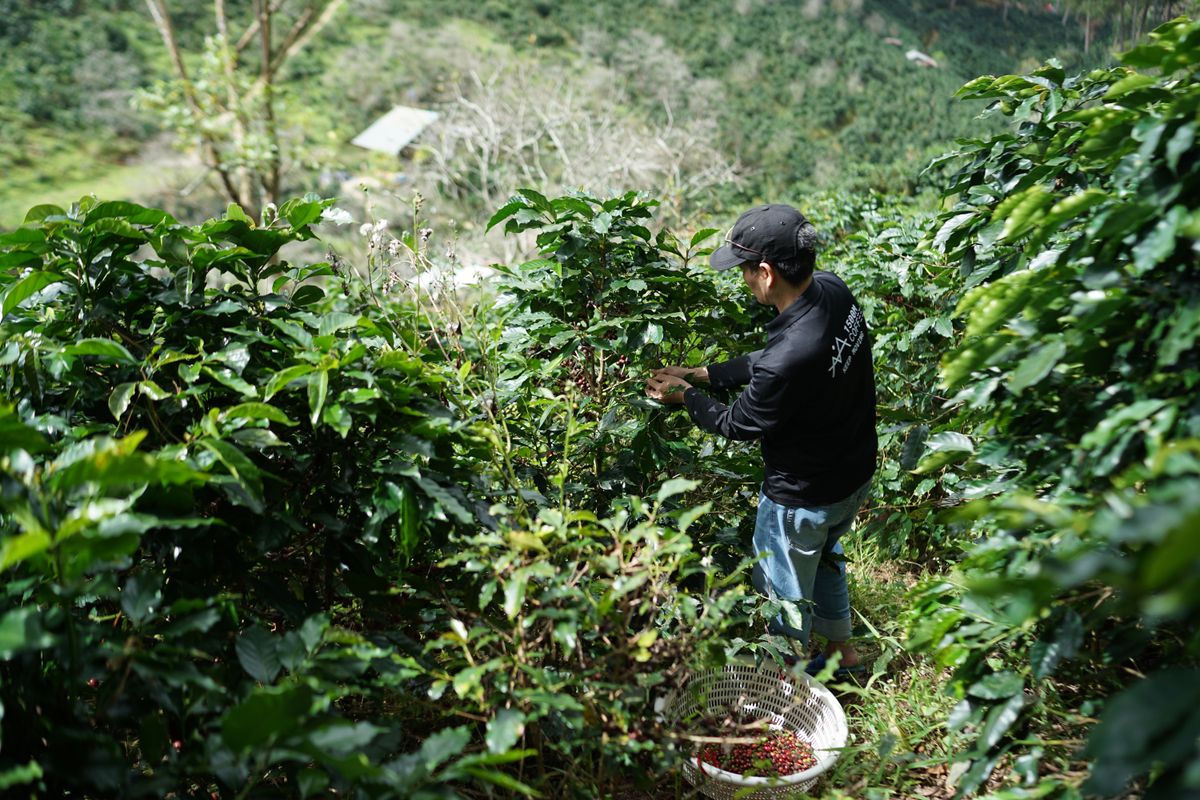
The single-origin story is just as strong and just as specific. Peruvian coffee is almost entirely Arabica, grown mostly between 1,000 and 1,800 meters across Cajamarca, San Martin, Junin, and Amazonas, in varieties including Typica, Caturra, Bourbon, Catimor, and increasingly Gesha. Altitude and shade create the sugar development that high cup scores reward, and the 2024 Cup of Excellence proved the ceiling: a top lot at 90.54 from El Mirador in Cajamarca, with 25 winning lots all scoring above 87. That quality is real, but it lives in named lots from named farms, not in the origin average.
The destination mix shows the demand is mature, not speculative. In 2024 the United States took about 27% of shipments by volume, Germany about 19%, and Belgium about 12%, with the European Union as a bloc near 46% and coffee reaching more than 50 markets. These are quality-sensitive buyers who reorder on consistency. The opportunity for an importer is to lock onto the specific farms and cooperatives that already meet that bar, before a competitor contracts the same lots.
Demand is concentrated in quality-sensitive markets: the US, Germany, and Belgium take well over half
Peruvian coffee reached more than 50 destination markets in 2024, with the European Union as a bloc near 46% of volume.
These three buyers alone accounted for well over half of shipments by volume, and they reorder on consistency.
Source: Peru Sourcing Partners analysis
So what: vet the farm and cooperative before the contract, not after the cup
The practical move is to stop sourcing the origin and start sourcing the lot. That means confirming the farm or cooperative, the altitude band, the variety, the processing method, the certification status, and a recent cup score before any contract, then verifying that the same source can repeat it at your volume. In a base of 855,000 smallholders, that vetting is the difference between a one-time sample and a multi-season supply line.
This is where a verified shortlist changes the economics. Rather than chasing offer sheets that all say Peru, a buyer works from a small set of farms and cooperatives already screened on cup score, certification, traceability, and the ability to deliver consistently. The fragmentation that makes Peru risky for the unprepared buyer becomes an advantage for the prepared one: more named lots to choose from, and more room to secure the right one.
If you are building or defending a single-origin or organic Peru program, the next step is a vetted shortlist of specific farms and cooperatives matched to your cup profile, volume, and certification needs. Request the introduction and start from sources that have already been checked on the ground, not from a label that only tells you the country.
Certified-organic demand more than doubled in a year while total volume eased
Organic shipments rose about 109% year on year in the January to November window.
Total export volume eased about 4% over the same period, so the gain was demand and price, not just more beans.
Source: Peru Sourcing Partners analysis
Get a vetted shortlist of Peru coffee farms and cooperatives matched to your cup profile
Tell us your target cup score, varieties, certifications, and volume. We return a short list of specific farms and cooperatives screened on the ground for quality, traceability, and the ability to deliver consistently, then make the introductions. You start from checked sources, not from a label.
Request an introductionCommon questions
Is Peruvian coffee actually high enough quality for a specialty program?
Yes, at the top of the base. Peru's 2024 Cup of Excellence winning lot scored 90.54, and 25 winning lots all scored above 87. The catch is that this quality lives in specific farms, varieties, and lots, not in the origin average. An 80-plus cup is sourced at the farm and cooperative level, not by the country name on the bag.
How fragmented is Peru's coffee supply, really?
Very. More than 855,000 people farm coffee on plots that are typically under five hectares, and the top five exporters move only about 41% of national export value. The rest flows through a long tail of cooperatives, traders, and intermediaries. That fragmentation is why two offers labeled the same way can cup completely differently, and why vetting to the farm matters.
Can I rely on organic certification when buying from Peru?
Peru is the world's leading organic coffee exporter, on roughly 90,000 certified-organic hectares, and certified-organic shipments more than doubled in value in the most recent reported window. Certification is genuinely deep here. Even so, certification status, traceability, and recent cup scores should be verified per source before contracting, because the base is large and uneven.
About the data: Figures reflect the latest full-year and most recent partial-year trade data for Peruvian coffee, cross-checked across at least two public industry sources; supply-side only. Figures reflect Peru export data curated and classified by Peru Sourcing Partners.
Specialty coffee and gourmet sourcing intelligence from Peru, straight to your inbox
a short brief on Peru sourcing, sent occasionally.